Tuesday, November 25, 2014

MELBOURNE

20th November, 2014

While camped on the Mornington Peninsular we took the opportunity to do a day trip into Melbourne city on the train.  With the train station right beside the campground it was an easy matter to walk over to the station and take the two carriage commuter train to Frankston.  The trains doing the round trip from Frankston to Flinders Street (the main train station in Melbourne) run every 15 minutes so it was a quick changeover from the Stony Point train to the Melbourne train and 40 minutes later we were standing on the platform in the heart of Melbourne’s CBD.  We crossed the road to the Information Centre in Federation Square
Information Centre in Federation Square
and from there we could really appreciate the ‘olde worlde’ architecture of the Flinders Street railway station
Flinders Street Station
and Saint Paul’s cathedral.
St Paul's
We’re not so sure about the modernistic style of architecture in Federation Square itself
Modern Architecture in Federation Square
but there was certainly something for everyone (architecturally speaking) on all sides of the square.  As we took in the high rise vista an icon of Melbourne’s public transport system rumbled by.
Melbourne Tram
We’re so happy that at least one capital city in Australia retained their tram system.  They might not be the best option for modern day commuters but for a hands on travel experience they can’t be beat.  We found where all the two wheel commuters park their motor bikes as we walked along Little Collins Street
Motor Bikes on the footpath in Little Collins Street
and in Collins Street itself we window shopped at all the brand name stores.
Collins Street
The security guard at Tiffany’s gave us a long hard look as we loitered in the doorway admiring some obscure architectural feature on the building opposite.  After wandering the streets we finally made our way back to the train station and crossed the bridge over the Yarra River
Melbourne high rise along the Yarra River
to the Arts Complex on the other side.
Arts Complex Melbourne
We were getting rather hungry as it was way past lunchtime so we stopped for a bite to eat at one of the many restaurants along the river at Southgate where we watched the tourist ferries plying up and down the river.
View across Yarra River to Flinders Station and Federation Square Melbourne
After our late lunch we strolled along the riverbank and eventually made our way back to the footbridge which crossed over to the train station.  We were amused to see the hundreds of locks that had been placed on the bridge railings.
Lovers Locks - Melbourne
The tradition of couples showing their commitment to each other by placing a lock on a bridge or railing of some structure seems to have also become quite popular here.  We saw many instances of this in lots of different countries on our overseas travels.  Before we made our way to the train station we took one last look at the view across the river to Southgate.
View across Yarra towards Southgate from Flinders Station
Our trip today was just to do a bit of sightseeing and enjoy the train journey without having the hassle of driving Mitzi in the city traffic and trying to find somewhere to park.  Our goal had been attained and the photos in this blog are just a snapshot of what there is to see in Melbourne.

MORNINGTON PENINSULA

13th November, 2014

After a detour into the northern suburbs of Melbourne to check out a new Crusader caravan for Roger and Gwen (Wok’s sister and brother-in-law) we headed south to the Mornington Peninsula and checked into the Stony Point Caravan Park on Westernport Bay.  The caravan park is situated right beside HMAS Cerberus naval base and is a stepping off point for a ferry to French Island and Phillip Island.
Stony Point Jetty
Besides the Stony Point Caravan Park there are only a couple of houses, a small shop, dockside offices for the Westernport Marine Authority and a train station where one can take a two carriage train to Frankston and then hop on a train to Melbourne.  It’s a great place for some quiet camping with the occasional day trip to explore the peninsula.  This is also a popular spot for local fishermen to launch their boats and after setting up the van on site we take a walk to the foreshore to see what type of fish the returning boats had brought back.  We weren’t the only ones interested in the catch and the fish cleaning tables were staked out by a bevy of pushy pelicans.
Pelicans at the fish cleaning table Stony Point
Two fishermen had just tipped their esky full of red schnapper onto the table and we chatted to them as they cleaned their catch.
Fisherman at Stony Point with his catch of red schnapper
All the while the ever vigilant pelicans and seagulls kept a watchful eye on the proceedings and were quick to snaffle up any discarded morsels.
Aww ... come on ... I'm being really really good ... !
Our first excursion is south along the eastern coast of the peninsula, popping in and out of the small seaside villages until we get to the most southern point at Cape Schanck.
Cape Schanck Lighthouse
Then we cross over the peninsula to the western side and Port Phillip Bay and follow the coast north checking out the seaside holiday villages of Sorrento, Rosebud and Dromana before climbing up to the lookouts at Arthurs Seat.  The views are fantastic with the peninsula spread out on both sides and disappearing into the haze.
View of Mornington Peninsula towards Point Nepean from Arthurs Seat
And we did actually find Arthurs Seat on top of Arthurs Seat.
Robyn takes it easy at Arthurs Seat
It was late afternoon by the time we followed the ridge road through Red Hill and back to Stony Point.  Our next excursion was to the furthest point on the Peninsula – Point Nepean National Park.  It was a lovely sunny day and the colour of the water was turquoise and blue – simply enchanting.  Point Nepean National Park is not fully accessible for private vehicles so we parked Mitzi and caught the shuttle bus into the park.  One of the first stops along the way is Cheviot Beach where a memorial to Prime Minister Harold Holt is located.
Cheviot Beach
We remember at the time the media frenzy surrounding the disappearance of Australia’s Prime Minister and the many rumours – from him being taken by a Great White Shark to being kidnapped by scuba divers from a Russian submarine.  The reality is that he more than likely was caught in an undertow and simply drowned but one can’t let the truth get in the way of a good story.  With no witnesses and no body the disappearance will always be a mystery and this secluded beach is now part of Australian history.

The shuttle bus winds its way along the narrow road out along the peninsula with Bass Strait on one side and Port Phillip on the other.
View back along the peninsula - Port Phillip Bay on the left and Bass Strait on the right.
The bus drops us off at the furthest point on the peninsula – Point Nepean.  There is a wonderful view of the entrance to Port Phillip from here.
View from Point Nepean across the entrance to Port Phillip Bay
The entrance to Port Phillip was the most heavily forted port of the British Empire with Fort Nepean standing guard over Bass Strait and the entrance to the bay.  Built in the 1870’s the fort was manned through both World Wars.
Wok makes his way towards the tunnels
We explore the tunnels
Wandering through the maze of tunnels
and fortifications and read the information boards which give us an insight into the history and life of the military personnel stationed here.


After wandering through the maze of tunnels and gun emplacements we eventually make our way back to the bus stop.  Point Nepean National Park was also home to a Quarantine Station which was established in 1852 and operated until 1952 when the buildings became home to the Officer Cadet School until 1985.  From 1985 to 1998 the buildings were used as a School for Army Health.  The site is now looked after by the National Parks and there are over 50 heritage listed buildings.
Avenue of trees at the Quarantine Station
We stroll around the site and through some of the buildings. 
Heat Oven for processing luggage of Quarantined passengers
There are five large buildings that were used as hospitals for sick passengers off the boats that entered Port Phillip.
One of the hospital buildings at the Quarantine Station
With many immigrants pouring into the colony in the second half of the 1800’s the outbreak of diseases such as typhus was a constant threat.  The tragic stories of those who were put into quarantine and those who died and were buried here are heart rending.  Some of Robyn’s ancestors may have passed through the Quarantine Station on their way to the Victorian goldfields in the 1850’s.  We wondered what they would have thought of this strange country so different to their home in Britain.
After leaving the National Park we followed the coast around Port Phillip Bay.  In the distance across the water we could just make out the outline of Melbourne’s high rise buildings in the haze.
View of Melbourne (in the haze) from Mornington Peninsula
All along the beaches on this side of the peninsula are colourful bathing sheds – a reminder of a bygone era.
Bathing sheds on Mornington Peninsula
Our time on the peninsula is nearly over and we’ve enjoyed exploring the many roads and by-ways that criss-cross its length.  Before we leave there was one last stop to make – sunset over the water at Portsea. 
Sunset at Portsea
Breathtaking ….. 

Monday, November 10, 2014

PHILLIP ISLAND

9th November, 2014

It’s not a long drive to switch camps today – just over 100 kilometres.  At San Remo we stop for a fish and chip lunch beside the bridge crossing from the mainland to Phillip Island.  The pelicans here also get a midday meal and there were coaches full of tourists (mainly asian) lined up along the foreshore eager to get that once in a lifetime photo.
Pelican Feeding time at San Remo
After lunch we drove over the bridge and along the road to Cowes (the main town on Phillip Island) passed the remains of chicory kilns – a thriving industry on the island in the late eighteen hundreds and early nineteen hundreds.
Chicory Kiln on Phillip Island
We check into Cowes Caravan Park which is situated on the foreshore of Western Port bay and that night while we are having dinner watch a family of rabbits munch their way through the grass around the van.  In the morning we hope into Mitzi and take a drive to The Nobbies at the western end of the island. 
The Nobbies on Phillip Island
A nature reserve has been established here and board walks guide visitors over nesting areas for marine birds to viewing platforms.
Boardwalks along the cliffs at The Nobbies
There were lots of seagulls diligently guarding nests
Seagulls nesting at The Nobbies
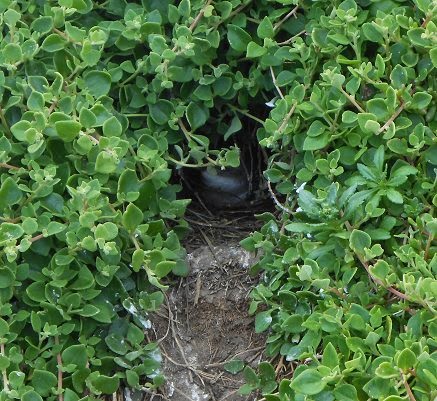
as well as burrows where penguin chicks were having a nap while waiting the return of their parents.
Peek-a-book penguin chick in its burrow
We can just make out the shape of Pyramid Rock in the distance so decide to take a walk along the coastal track for a closer look.
Pyramid Rock on Phillip Island
There are signs along the boardwalks giving information on the local wildlife and we were surprised to see this copperhead snake trying to sun itself under a “Stay on the Path’ sign.
Copperhead Snake under sign on coastal walk near Pyramid Rock
As copperhead snakes are venomous we left it up to its own devices and continued on our merry way.  The main tourist attraction on the island is the nightly penguin parade when the adult penguins return to their burrows to feed the chicks.
Penguin Parade
The viewing of the penguins is strictly supervised and tracks are kept clear to allow the penguins access to their burrows without being harassed by over enthusiastic humans.The following day we drive to Cape Woolamai and take a walk along the beach.
Cape Woolamai
Then it was time to undo all the good those nice long walks had done – a well deserved stop at the chocolate factory where this sign only confirmed our rationale for being there.
We wandered through the museum where the chocolate sculptures were truly remarkable.
Chocolate sculpture of 'David' ... even the leaf is chocolate
And this model train chocolate town would satisfy two male passions.  Eating chocolate and playing with trains ...
Chocolate model train village - even the streets are chocolate !
We had a great time trying to win chocolate balls on the fun parlour games in the museum and making chocolate shapes with the aid of a specially designed machine.  We then got to eat our masterpieces .... yummm!   And sitting amongst giant chocolate bars is what dreams are made of.
No Wok!  You can't stay there ...
There are lots of conservation efforts being undertaken on Phillip Island – from marine animals, to seabirds, to koalas.  All worthy causes which have been managed well on the island for a number of years.  We’ve enjoyed our stay here and tomorrow we will cross the bridge and head back to the mainland.  There is one last piece of information that we gleaned from the chocolate factory which we believe bears some consideration and that is
 
Yep ... sounds just about right to us !